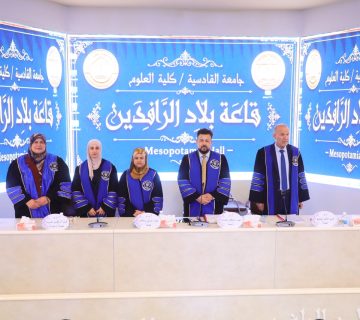
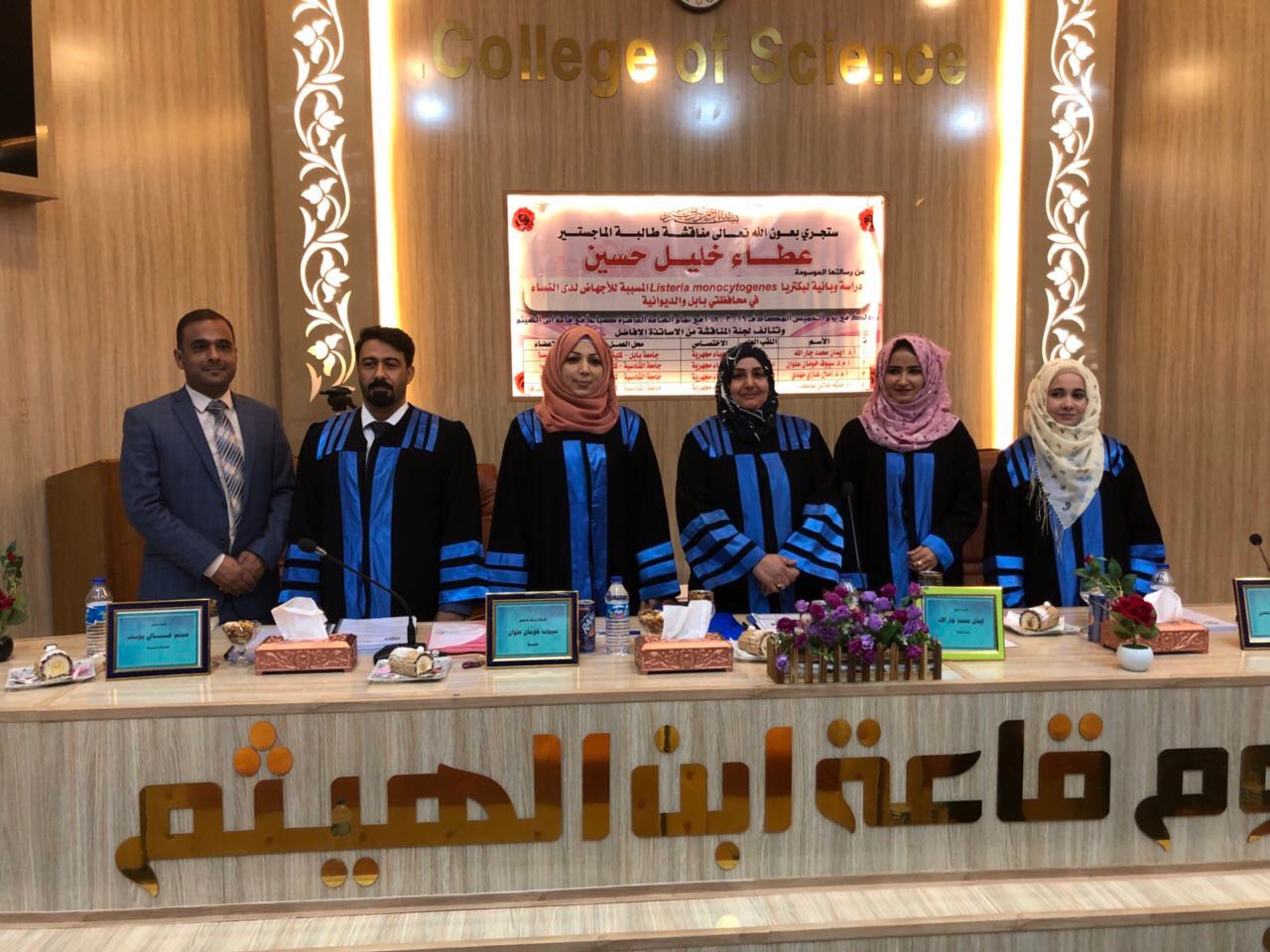
على قاعة أبن الهيثم في كلية العلوم بجامعة القادسية جرت مناقشة الدراسة المُعَدة من قبل الطالبة عطاء خليل حسين تحت عنوان دراسة تشخيصية وجزيئية لبكتريا Listeria monocytogenes المعزولة من مصادر مختلفة في محافظتي بابل والديوانية. بأشراف أ.د ميثم غالي يوسف … وتناولت الدراسة التياجريت خلال الفترة من تشرين الثاني 2016 الى ايار 2017, جمع العينات السريرية من النساء اللواتي يعانين من حالات الاجهاض ضمن 24 اسبوع خلال فترة الحمل. اذ جمعت العينات تحت اشراف طبي متخصص وكان عدد العينات المأخوذة 92 عينة سريرية من مستشفى بابل للنسائية والاطفال التعليمي و 83 عينة سريرية من مستشفى الديوانية للنسائية والاطفال التعليمي حيث تضمنت العزلات عينات المشيمة والمسحات المهبلية. في حين جمعت عينات الاغذية بصورة عشوائية من اسواق في مناطق مختلفة في محافظتي بابل ومحافظة الديوانية والتي شملت (69) عينة جبن , (58) عينة لحوم حمراء مجمدة و (51) عينة لحوم دجاج مجمدة.
تم عزل بكتريا Listeria monocytogenes بأستخدام وسط زرعي اختياري خاص ببكتريا L. monocytogenes مع اضافة المعزز الحيوي الذي يساعد على نموها وتثبيط نمو الانواع الاخرى من البكتريا, وشخصت العزلات بأستخدام الفحص المجهري والاختبارات الكيموحيوية. اظهرت النتائج ان نسبة العزل لبكتريا L. monocytogenes كانت 13(3.68%) عزلة من مجموع 353 عينة وشملت :6(3.42%) عزلات من مجموع 175 عينة سريرية و 7(3.93%) عزلات من مجموع 178 من عينات الاغذية, حيث كانت نسبة العزل في محافظة بابل 3(3.26%) عزلة من مجموع 92 عينة و في محافظة الديوانية 3(3.61%) من مجموع 83 عينة. كما كانت نسبة عزل البكتريا من الاغذية 3(4.35%) من مجموع 69 عينة جبن, و 2(3.92%) من مجموع 51 من عينات لحوم الدجاج و 2(3.44%) من عينات اللحوم الحمراء.
كما بينت نتائج هذه الدراسة ان اكثر فئة عمرية معرضة للاصابة بعدوى بكتريا L. monocytogenes هي (26-30) سنة حيث كانت تمثل نسبة ( 3(5.17% و كانت النساء الأكثر اصابة لعدوى البكتريا خلال الأشهر الثلاثة الأولى (أقل من 12 أسبوع من عمر الحمل) كانت بنسبة 5(5.15%) وكان أكثر المرضى إصابة من المناطق الريفية 4(4.39%) .
استخدمت تقنية (PCR) Polymerase chain reaction لتأكيد تشخيص عزلات بكتريا L. monocytogenes من خلال الكشف عن جينات الضراوة (hlyA, prfA, inlA, actA, plcA, iapA), اذ كانت نسبة ظهور هذه الجينات 100% لجميع عزلات بكتريا L. monocytogenes.
كما تم استخدام تقنية تسلسل الحامض النووي DNA sequencer وتحليل الشجرة الوراثية Phylogenetic tree analysis على اساس تسلسل جين (hlyA) الذي يعتبر الجين التشخيصي لبكتريا L. monocytogenes عن باقي انواع Listeria spp. باستخدام برنامج (MEGA 6) وكان تحليل الشجرة الوراثية المستخدم من نوع (UPGMA tree ), لخمس عزلات من خمس مصادر عزل مختلفة قيد الدراسة. اظهرت نتائج التحليل الوراثي وجود تقارب جيني بين العزلات المحلية والعزلات المسجلة عالميا في بنك الجينات كما اعطت نتائج التحليل الجيني وجود نسبة تقارب جيني بين العزلات الغذائية اكثر مقارنة مع العزلات السريرية كما اظهرت نتائج التحليل الجيني لنسبة احتمالية حدوث الطفرات Transition substitution mutation اكثر من حدوث طفرات Transversion substitution mutation ضمن تتابع تسلسل الجينات بين العزلات المحلية والعزلات المسجلة عالميا.
______________________________________
The study was conducted during the period from January 2016 to May 2017. Clinical samples were collected from women suffering from miscarriage before 24 weeks of gestation,the samples were collectedunder specialized medical supervision.The number of samples taken was 92 clinical samples fromBabylon Teaching Hospital of Gynecology and Pediatrics and 83 clinical samples from Maternal and Children Hospital in Al- Qadisiyah provinice. Food samples were randomly collected from supermarkets in different areas of Babil and Qadisiyah governorates, which included 69 samples of
cheese, 58 frozen red meat, 51 frozen chicken meat samples. Listeria monoytogenes were isolated using a selective media L.monocytogenes, with the addition of a supplement that helps to grow L.
monocytogenes and inhibit the growth of other types of bacteria. The isolates were identified using microscope and biochemical tests. The results showed that the isolation rate of L. monoytogenes was 13 (3.68%)of the total number of 353 isolates and 6 (3.42%) isolates out of 175 clinical samples and 7 (3.93%) isolates out of 178 food samples, In Babil province 3 (3.26%) isolation from the total of 92 samples and in AlQadisiyah province 3 (3.61%) of the total of 83 samples. 3 (4.35%) oftotal 69 samples of cheese, 2 (3.92%) of 51 chicken meat samples and 2 (3.44%) of 58 red meat samples were isolated.The results of this study demonstrated that the most age group was exposed to L. monoytogenes infection (26-30), which represented 3 of total 6 (5.17%). The women were most infected with bacteria during the first three months (less than 12 weeks of gestational age) 5 of total 6 (5.15%) were the most infected patients of rural areas 4 of total 6(4.39%). PCR technique was used to confirm the diagnosis of L. monoytogenes isolates by detecting the virulence genes (hlyA, prfA, inlA, actA, plcA, iapA), as the percentage of the appearance of these genes was 100% for
all isolates of L. monoytogenes. DNA sequencer technique and phyloggenetic tree analysis were based on hlyA gene sequence clearly detection L. monocytogenes, could be the reliable option to indicate presence of L. monocytogenes. In the present study, we identified 5 isolates of L. monocytogenes from clinical and food samples based on hlyA gene sequence. Using MEGA 6 software, and UPGMA tree analysis (Unweighted Pair Group Method with Arithmetic Mean). Our results demonstrate the relationship between the local isolates with the other Gene Bank isolates, and also showed a genetic affinity in the isolates of L. monocytogenes isolated from food samples compared to the
clinical isolates. Also showed a higher probability of transition substitution mutation than transversion substitution mutation within the sequence of gene between local isolates and globally recognized isolates.