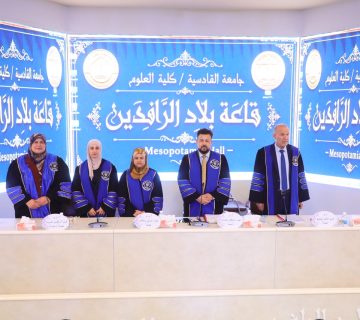
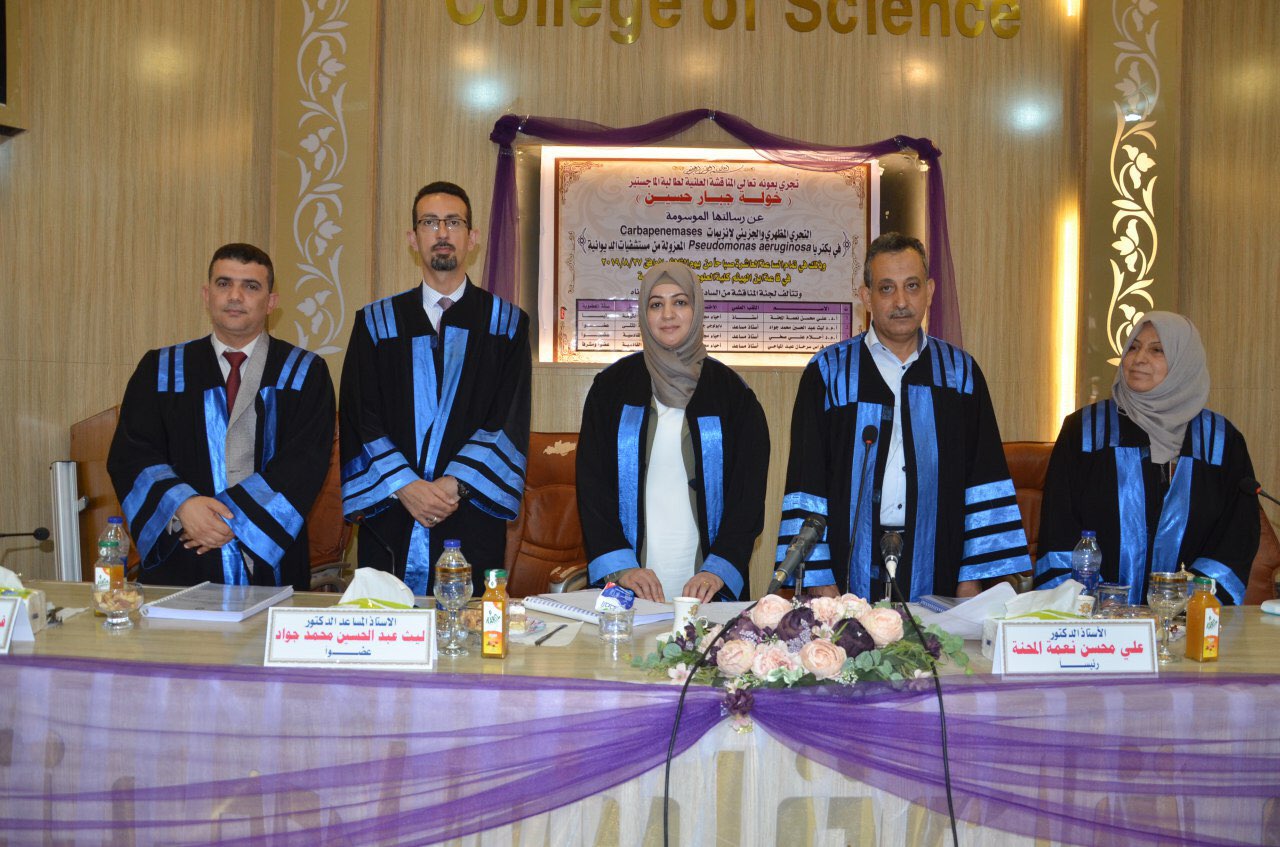
في كلية العلوم وعلى قاعة ابن الهيثم تمت مناقشة رسالة ماجستير للطالبة (( خولة جبار حسين العابدي )) تحت عنوان ((التحري المظهري والجزيئي إلنزيمات Carbapenemases في بكتريا aeruginosa Pseudomonas المعزولة من مستشفيات الديوانية))…كانت الرسالة باشراف ا.م.د.فراس سرحان المياحي.
تضمنت الدراسة نتائج واستنتاجات تلخصت في الملخص ادناه:
The present study aimed at investigating the spread of carbapenemase-producing isolates of Pseudomonas aeruginosa recovered from some hospitals and specialized health centers in Al-Diwaniyah City, Iraq, using morphological and molecular methods. For this purpose, 630 clinical samples were collected during the period from July to December, 2018. These samples included 244 burn swabs, 163 sputa, 115 urine samples, and 108 ear swabs. The results of the biochemical and confirmation tests, API 20 E and Vitek 2 system, showed that 100 isolates belonged to P. aeruginosa. A Kirby-Bauer-based survey was performed to test the isolate sensitivity to 15 antibiotics. The results demonstrated that 64% of the isolates were multi-drug resistant (MDR) and 36% isolates revealed extensively drug-resistant (XDR). The antibiotic resistant activity showed that 10% of the isolates were pandrug-resistant (PDR). Moreover, 24% of the isolates displayed resistance against carbapenems. For the meropenem, 100% of the isolates revealed resistance to this drug. The current work also explored the carbapenemase production ability of the carbapenem-resistant isolates using morphological and molecular methods. doubledisk synergy test (DDST), combined disk test (CDT), and modified hodge test (MHT) were used to investigate this ability of producing carbapenemase. Interestingly, the results showed that 95.83%, 91.67%, and 12.5%, respectively, of the isolates were positive to these tests. The carbapenemase production ability by 24 CR isolates was investigated using a monoplex polymerase chain reaction technique targeting 12 different coding genes for this enzymes (8 metallo-β-lactmases (MBLs) and 4 serine carbapenemases (SCMs). The results of the PCR test showed the presence of blaVIM, blaSPM, blaGIM, Summary B blaNDM, blaAIM, blaSIM, and blaDIM genes in 16 (66.6%), and 14 (14.3%), 13 (54.1%), 1 (36.5%), 9 (37.5%), 8 (33.3%), 2 (8.3%), respectively, of the isolates. No detection of the blaIMP was observed. The results of the serine carbapenemases related monoplex PCR showed the occurrence of the blaGES, blaSME, blaKPC, and blaOXA-48 genes in 20 (83.3%), 19 (79.1%), 11 (45.8%), 18 (75%), respectively, of the isolates. The study also detected the nucleotide sequences of the monoplex PCR-positive metallo-β-lactmases and serine carbapenemases genes in 10 and 7 isolates, respectively. The phylogenetic study analysis revealed high, 99%, identity with NCBI-related world strains. According to the best of our knowledge, this is the first study in Iraq that detects a group of encoding genes of carbapenemases in carbapenem-resistant isolates included. blaVIM-1, bla SPM-1, blaGIM-1, blaAIM-1, blaSIM-2, and blaDIM-1, blaGES-39, blaSME-1, blaKPC-5, and blaOXA-48